
The Artist That’s Reshaping Diversity in Hip Hop
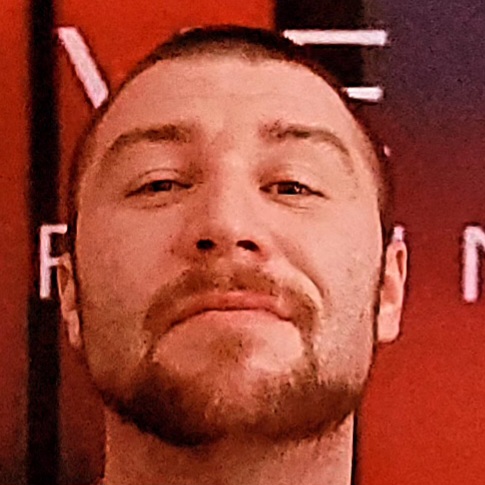
Thaddeous is building something difficult to categorize—and increasingly difficult to ignore.
There are artists who enter hip-hop looking for a place within the culture.
Then there are artists who spend their careers trying to expand what that place can be.
Thaddeous belongs to the latter.
Born in York, Pennsylvania and raised across Jackson, Mississippi, Philadelphia, and Northeast Pennsylvania, Thaddeous Leon Mann has developed an artistic identity shaped less by geography than by the collision of environments. His music carries the density of traditional hip-hop, the introspection of a writer, the atmosphere of experimental music, and the visual sensibility of a multidisciplinary artist.
He has described his sound as “celestial hip-hop”—a concept built around cosmic imagery, introspection, spirituality, storytelling, and atmospheric production. The label is more than a genre tag. It represents an attempt to give language to music that does not comfortably fit inside the increasingly narrow categories used to market contemporary hip-hop.
That refusal to fit neatly may ultimately be one of Thaddeous' defining characteristics.
But the story behind the artist is just as important as the music.
From Lyfe3x to Thaddeous
LYFE3X
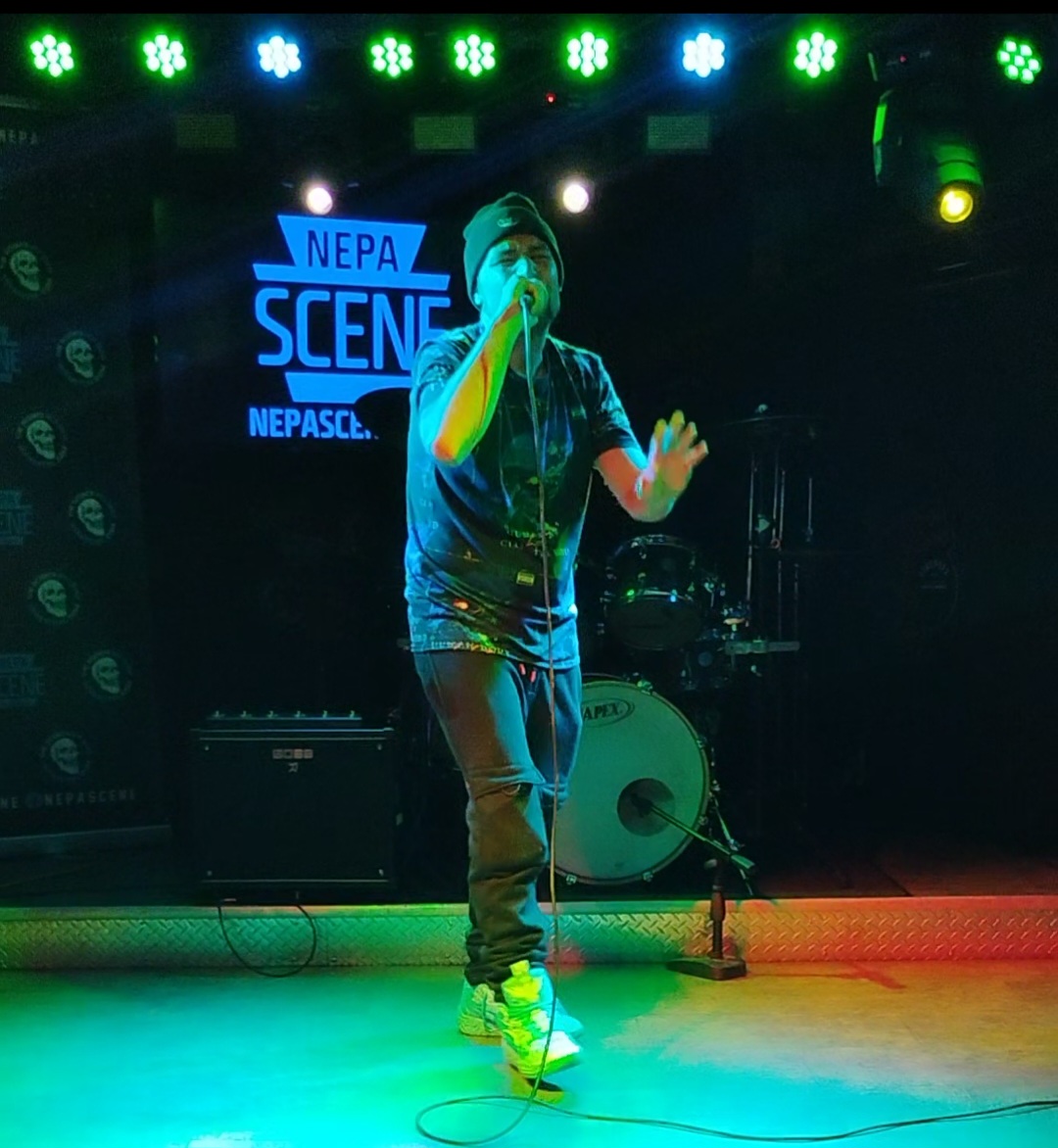
For years, the artist was known professionally as Lyfe3x.
That era produced a substantial body of work, collaborations, experiments, performances, and infrastructure. His catalog expanded across projects ranging from Human Body Celestial Mind to The Reign Begins, while collaborations and releases continued to establish his presence within independent hip-hop. Public streaming records document releases under the Lyfe3x name throughout 2025 and into early 2026.
But eventually, the name became smaller than the person behind it.
The transition to Thaddeous was therefore not simply a rebrand.
It was an artistic separation between who he had been and what he was becoming.
The change coincided with a larger restructuring of his creative world: music, publishing, business infrastructure, visual identity, catalog management, live performance, direct-to-supporter marketing, and the development of Black Letter.
Rather than treating music as isolated songs released into an algorithm, Thaddeous began treating his career as an interconnected body of work.
That distinction matters.
Because Thaddeous is not simply trying to release more music.
He is building an archive.
THADDEOUS
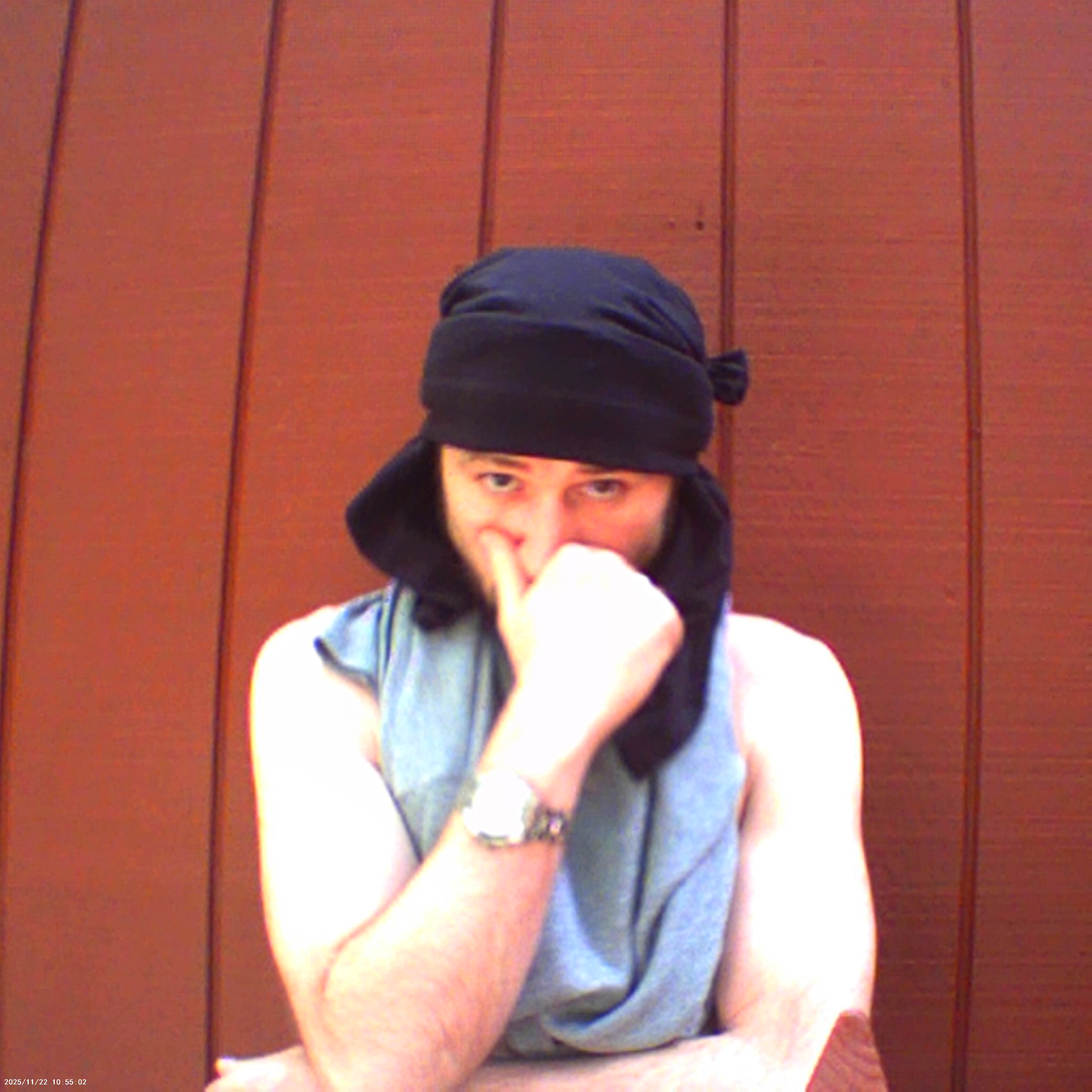
A catalog built on documentation
One of the most unusual aspects of Thaddeous' development is the sheer emphasis he places on ownership, documentation, and permanence.
His philosophy can be summarized in three words:
Records. Not Moments.
That philosophy appears repeatedly in the way he approaches his work.
Registrations, ISRCs, publishing, master ownership, editions, alternative versions, archival documentation, visual assets, direct distribution, and release architecture have all become part of the creative process rather than administrative afterthoughts.
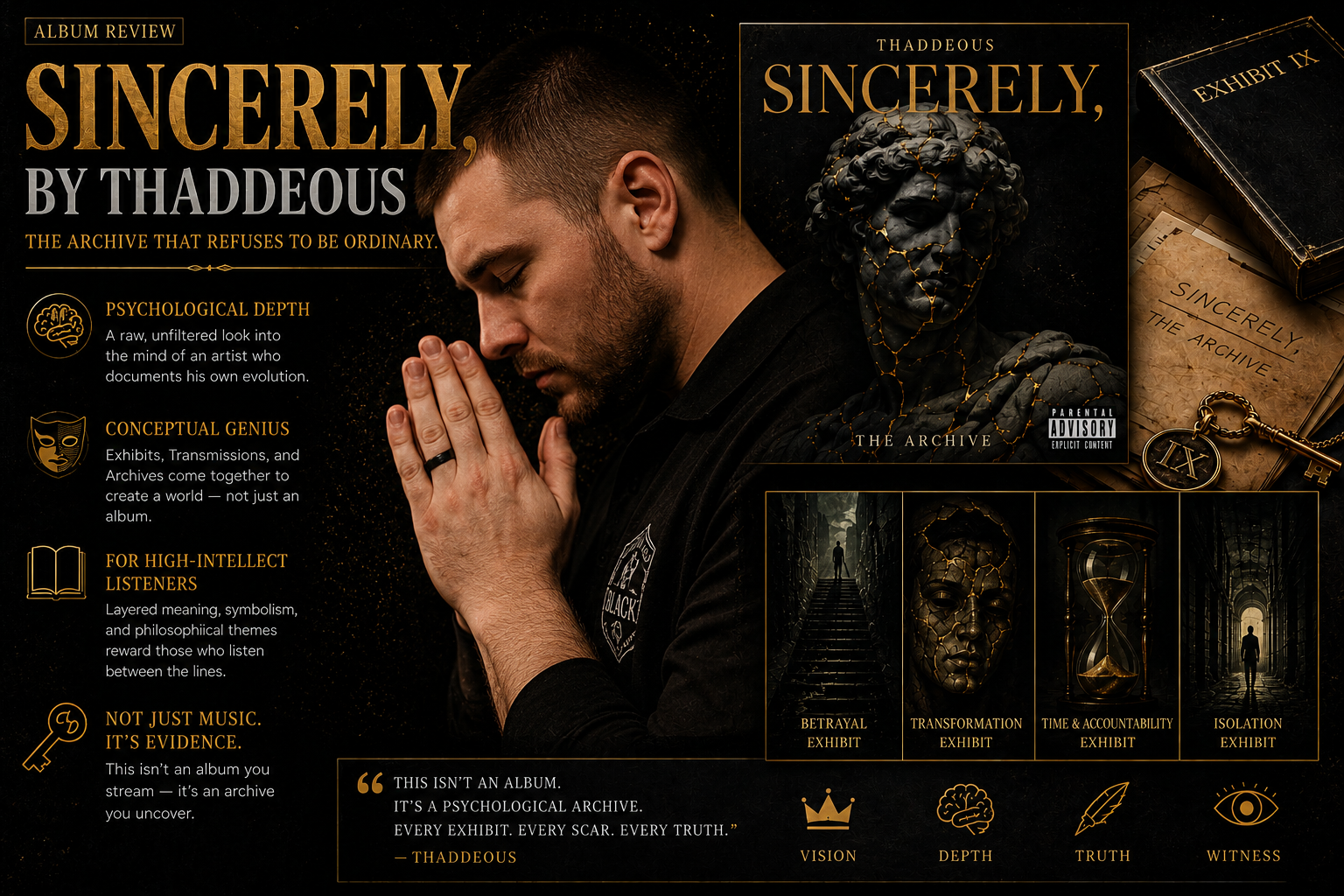
That approach is particularly visible in Sincerely, released April 12, 2026.
The project is presented not simply as an album but as a collection of eleven exhibits—a work concerned with grief, endurance, accumulation, stillness, and presence. Its official description explicitly frames each track as a document rather than merely a song, emphasizing restraint and permanence over immediacy.
That philosophy extends into his newest chapter.
My Life's Been Crazy
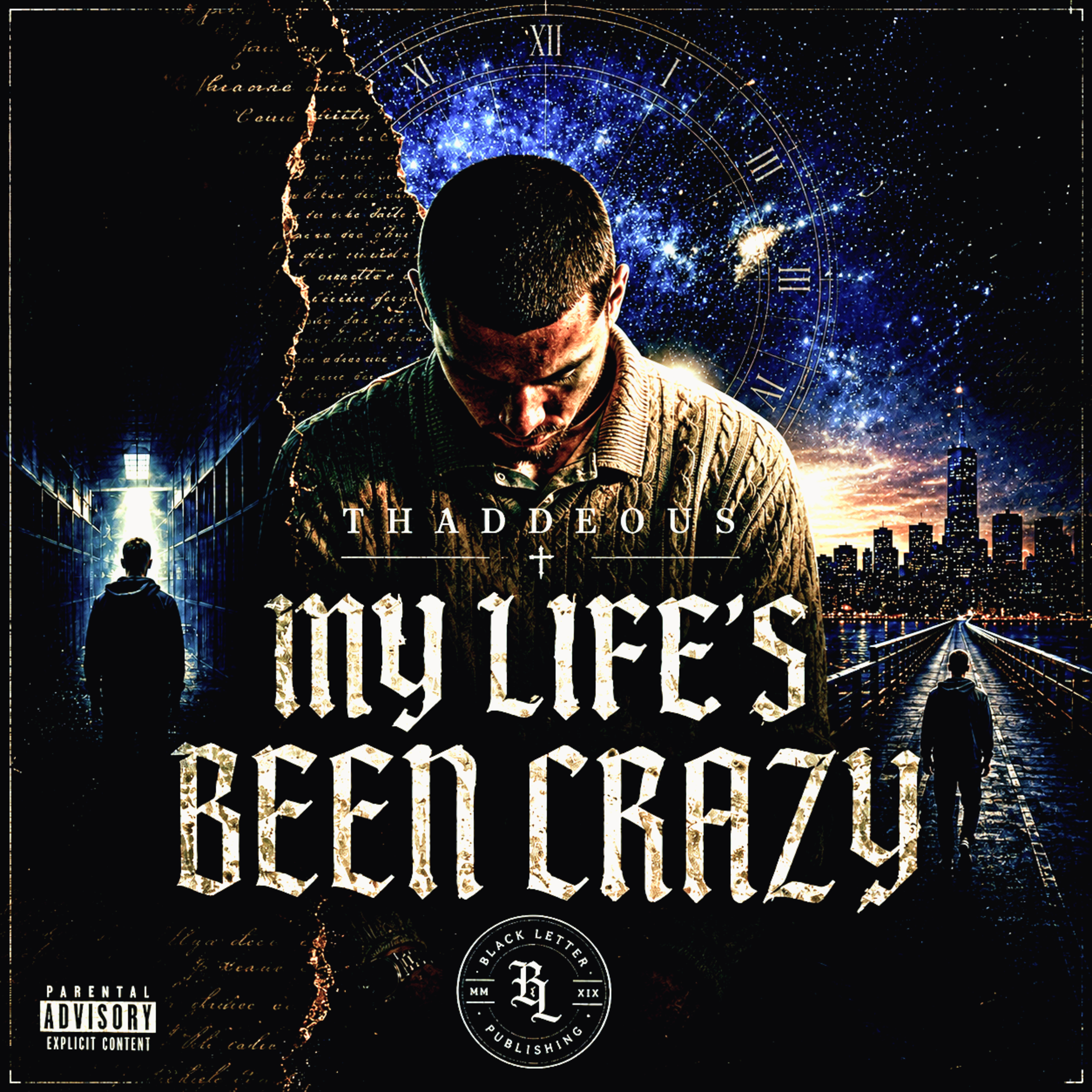
If Sincerely, represents restraint, My Life's Been Crazy represents confrontation.
The project is autobiographical in its premise and expansive in its execution. It is simultaneously an album, a performance concept, a documentary framework, and an examination of the experiences that brought Thaddeous to this point.
The title is deceptively simple.
Behind it sits a life that has moved through multiple cities, multiple identities, multiple artistic eras, setbacks, reinvention, loss, uncertainty, ambition, and persistence.
Rather than hiding that complexity, Thaddeous has made it part of the architecture.
The project has also demonstrated a willingness to bring the work outside the studio. In August 2026, Thaddeous held a My Life's Been Crazy debut performance event in Scranton, Pennsylvania, positioning the project as a live experience rather than something designed solely for streaming platforms.
That distinction increasingly defines his approach.
The record is not the end product.
The record is the evidence.
The independent artist problem—and Thaddeous' response
The independent music industry often presents artists with a false choice:
Be completely independent and remain small, or surrender control in exchange for access.
Thaddeous has increasingly rejected that premise.
His approach has been to construct the infrastructure himself.
He has worked through publishing, distribution, licensing, registration, branding, direct communication, live performance, visual content, audience development, and networking while simultaneously developing the artistic product.
That has created an unusual situation.
Thaddeous is simultaneously the artist, archivist, strategist, writer, creative director, and architect of his own ecosystem.
It is undoubtedly a difficult path.
It is also a path that gives him something increasingly valuable in modern music:
context.
When an artist owns the story surrounding the music, the audience receives more than isolated releases.
They receive a world.
The setbacks became part of the work
No serious artistic career is constructed without resistance.
Thaddeous' story includes periods where progress was not linear, opportunities did not materialize as expected, systems had to be rebuilt, and personal circumstances collided with professional ambitions.
There were moments when the easier decision would have been to abandon an old identity, abandon the catalog, or simply chase whatever opportunity appeared next.
Instead, he repeatedly rebuilt.
The most important characteristic of those setbacks may not be that they happened.
It is what they produced.
They forced Thaddeous to become increasingly intentional about ownership, documentation, relationships, presentation, and the difference between attention and progress.
That distinction has become central to his philosophy.
A follower is not necessarily a supporter.
A stream is not necessarily a relationship.
An opportunity is not necessarily a career.
And being noticed is not the same thing as being established.
Diversity beyond demographics
The word “diversity” is often reduced to demographics.
Thaddeous' story suggests another interpretation.
Diversity can also mean diversity of artistic thought.
Hip-hop has always contained multitudes: boom-bap and trap, poetry and commerce, street reportage and futurism, political commentary and escapism, sampling and synthesis, vulnerability and bravado.
Thaddeous operates inside that tradition while attempting to add another dimension.
His work moves between conscious rap, alternative hip-hop, storytelling, experimental composition, spirituality, cinematic atmosphere, and personal documentation. His public artist materials similarly describe the music through terms including alternative hip-hop, conscious rap, contemporary hip-hop, and contemporary R&B.
The result is not necessarily music that asks to be categorized.
It is music that asks whether the categories are still large enough.
That is where the idea of celestial hip-hop becomes significant.
Whether the term eventually becomes widely adopted is almost beside the point.
Creating a language for your own work is itself an act of artistic independence.
From NEPA to something larger
Thaddeous' trajectory also reflects an increasingly important reality in contemporary music: an artist does not necessarily have to come from one of the traditional centers of the industry to develop a meaningful artistic identity.
York.
Jackson.
Philadelphia.
Northeast Pennsylvania.
Those places are not footnotes in his story.
They are ingredients.
His relationship with NEPA has been particularly important to his live development, but the artist has increasingly begun looking beyond the local circuit. The next phase involves expanding his performance network into larger markets, particularly Pennsylvania and New York City, while presenting himself not as a beginner searching for a stage but as an established independent artist bringing an existing catalog, live experience, visual identity, and professional infrastructure into new rooms.
That is a different proposition.
He is no longer asking:
“Where can I perform?”
He is increasingly asking:
“Where does this work belong next?”
The next chapter
The most interesting part of Thaddeous' story may be that the traditional breakthrough narrative does not adequately describe where he is now.
There is no single moment that explains the trajectory.
There is a catalog.
There are performances.
There are experiments.
There are failures.
There are rebuilt systems.
There are thousands of decisions that rarely make headlines but determine whether an artist can sustain a career.
And there is an increasingly defined philosophy behind all of it.
Thaddeous is moving toward a model in which the music, the business, the visual identity, the documentation, the live experience, and the intellectual framework all reinforce one another.
That creates possibilities far beyond the conventional artist cycle of:
single → promotion → release → disappear → repeat.
The emerging Thaddeous model is closer to:
work → document → perform → archive → expand → reinterpret.
That model allows the artist to grow without abandoning the work that came before.
What is Thaddeous actually building?
It would be easy to describe Thaddeous as an independent rapper from Pennsylvania.
It would be accurate.
It would also be incomplete.
He is building a body of work around the idea that an artist can be simultaneously commercial and intellectual, traditional and experimental, vulnerable and authoritative, local and expansive.
He is demonstrating that hip-hop does not have to become less hip-hop in order to become more diverse.
It can simply become larger.
And perhaps that is the real significance of Thaddeous.
Not that he has already reached some predetermined destination.
Not that every experiment has worked.
Not that every opportunity has materialized.
But that he continues to expand the definition of what his own career can be.
The Lyfe3x era established the foundation.
Thaddeous is building the institution.
The catalog is growing.
The live performance is becoming more central.
The visual language is becoming more deliberate.
The business infrastructure is becoming more sophisticated.
And the music is becoming increasingly concerned with something that outlives the moment in which it was created:
permanence.
In an industry obsessed with what is happening next, Thaddeous appears increasingly interested in what will still matter afterward.
That may be the most compelling part of the story.
Because the artist reshaping diversity in hip-hop may not be the artist trying to become something the culture has never seen.
It may be the artist insisting that there is still room within hip-hop for an individual to become something the culture has not yet had a name for.